by: Derwin Pereira
Published in The Edge (Singapore)
Asian Viewpoint, August 3, 2026
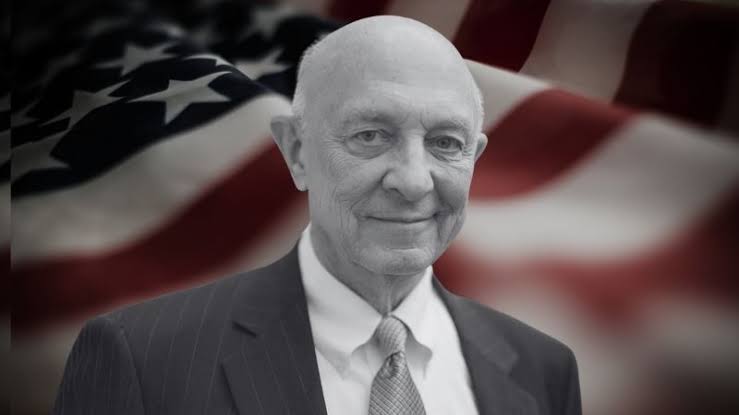
The death of Robert James Woolsey in Washington on July 21 at the age of 84 marks the passing of not just an extraordinary man but of an entire era in American intelligence – that in which the US and the Soviet Union were locked in the deadly logic of the Cold War.
Woolsey, an Advisor Emeritus of Pereira International, was a Director of the Central Intelligence Agency (CIA) who had served previously in the US government on five different occasions. Remarkably, he held presidential appointments in two Republican and two Democratic administrations. He was a bipartisan American who tried to serve his country no matter who was in power.
During his long years of government service, he headed the CIA from 1993 to 1995 under President Bill Clinton. That role defined him till his death, but he had played many other roles as well.
In the 1970s, he was an advisor on the US Delegation to the Strategic Arms Limitation Talks
(SALT I) in Helsinki and Vienna: General Counsel to the US Senate Committee on Armed Services; and Under-Secretary of the Navy. In the 1980s, he was Ambassador to the Negotiation on Conventional Armed Forces in Europe, and was also involved with the US-Soviet Strategic Arms Reduction Talks (START) and the Nuclear and Space ArmsTalks. He held many other positions as well, applying his mind to the urgent questions that the US faced in maintaining its lead over the Soviet Union in the battle for the world.
Woolsey had applied his mind wel inschool. A Phi Beta Kappa (a graduate withgreat distinction) of Stanford University, he was a Rhodes Scholar at Oxford andreceived an LL.B. from Yale Law School. He practised law successfully in the US, but his true calling lay elsewhere: in taming the lawlessness of world affairs, admittedly to American advantage.
Woolsey’s liberal impulses recognised that America could retain its hegemonic position in global affairs only if it offered the world something more than the soulless totalitarianism of the Soviet Union. The US would have to preserve its position as the City on a Hill – a Biblical aspiration whose secular underpinnings lay in freedom and democracy here and now.
Woolsey believed that citizens should behave as producers of power and not as products of the power of the state and the market. However, the power of the individual itself could not be guaranteed without a strong state capable of protecting liberal American values through economic power, military might and Intelligence.
Drawn instinctively to the Democratic Party, he became a Defence Democrat (or a neoconservative Democrat, although he dismissed this particular label). Essentially, he was hawkish on foreign policy issues but liberal on domestic economic and social issues. That was his answer to the Soviet Union – a country hawkish on global issues and even more hawkish on its own citizens.
The fall of the Berlin Wall in 1989 and the implosion of the Soviet Union in 1991 revealed how the US had managed to contain the communist threat. But the threat continued in a different form. Russia, the inheritor state of the Soviet Union, followed its predecessor in maintaining Leninist control over politics even as it relinquished the command economy system associated with the previous regime.
Woolsey’s work as CIA Director took place in the context of this Russian transition. It was not a happy time in his career. He faced up to lawmakers who wanted deep cuts to the CIA’s budget because the Cold War had ended. He also had limited access to Clinton. According to a journalist: “Never once in his two-year tenure did CIA director James Woolsey ever have a one-on-one meeting with Clinton. Even semi-private meetings were rare. They only happened twice. Woolsey told me: ‘It wasn’t that I had a bad relationship with the president. It just didn’t exist.’ ” But the non-existent relationship did not cost Woolsey his infectious sense of humour. He said: “Remember the guy who in 1994 crashed his plane onto the White House lawn? That was me trying to get an appointment to see President Clinton.” Being a Defence Democrat did not help in the Administration of a pacifist president.
But what hurt Woolsey professionally was the case of Aldrich Ames, a CIA officer who confessed to having betrayed Western intelligence assets to the Soviet Union and Russia. Ames was arrested in February 1994. Many wanted exemplary sanctions imposed on the man’s supervisors because they had failed to pay enough attention toAmes’s rising standard of living. Ames admitted receiving U S $25 million from Moscow for US secrets between 1985 and 1994.
There was an uproar in Congress when Woolsey decided that no one in the CIA would be dismissed or demoted as a result. He declared: “Some have clamoured for heads to roll in order that we could say that heads have rolled… Sorry, that’s not my way.” Woolsey did not want morale at the agency to suffer because of one traitor. He resigned abruptly in December 1994. Life continued, with him contributing in many areas of American (and international) economic and intellectual life. His wife, Conchita, stayed by his side even as age caught up with him.
But his past never left him. The cloak-and-dagger world of espionage in which he had engaged during his CIA years had an unlikely impact on him, in the form of the debilitating Havana Syndrome from which he suffered. His wife said that his health began to deteriorate as a direct result of the syndrome, which produces symptoms from hearing loss and fatigue to memory lapses and cognitive problems. According to a news source, more than 1,500 cases of the Havana Syndrome have been reported by American intelligence and diplomatic personnel in dozens of countries, including the US, ever since it appeared in Cuba in 2016. Havana is Cuba’s capital; hence the provenance of the syndrome’s name.
Russia has been suspected in the attacks, which avowedly involve a miniaturised microwave weapon, but the charges remain unproven. Even so, I remember James as a person with what is called hunter’s eyes: He was always looking around for those who might prey on his country, his values and himself. In the course of my interactions with him, we discussed US’s relations with China and Southeast Asia. I found him alert, attentive and astringent.
Goodbye, friend.
The writer is Founder and CEO of Pereira International, a Singapore-based political and strategic consultancy. An award-winning journalist and a graduate alumnus of the Kennedy School of Government at Harvard University, he is also a member of the Board of International Councilors at the Center for Strategic and International Studies in Washington DC. This article reflects the writer’s personal views.